
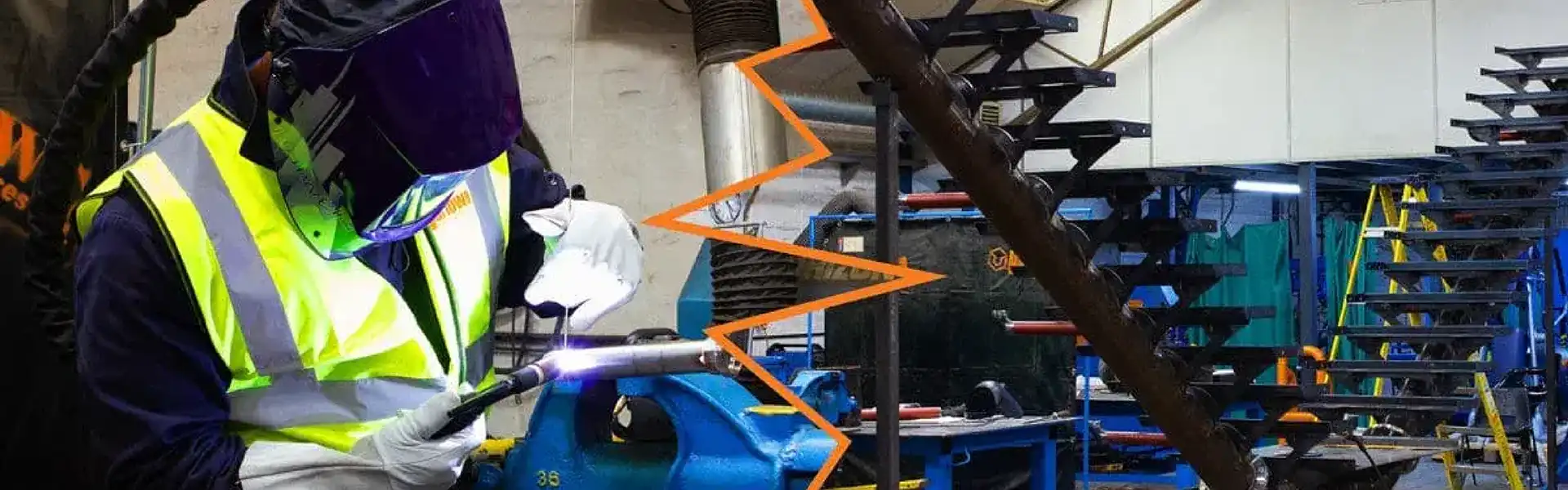
The short answer: Fabrication is the complete process of making a metal structure — cutting, forming, drilling, fitting, and joining. Welding is one of the joining methods used within fabrication. All welding is part of fabrication, but fabrication involves far more than welding alone. The two are complementary, not interchangeable.
Welding and fabrication are closely related but distinct disciplines. Understanding the difference matters when you're specifying work, selecting a contractor, or communicating scope — getting the terminology wrong can lead to mismatched expectations and incomplete quotes.
Steel fabrication is the complete process of transforming raw metal stock — plate, section, tube, or bar — into a finished structure or product. It encompasses every stage from initial cutting through to assembled, finished, and inspected output ready for installation or use. Common fabrication processes include:
Visit our steel fabrication services page for more detail on what Varlowe provides.
Welding is the process of permanently joining two or more pieces of metal by applying heat, pressure, or both — melting the base materials together, typically with the addition of a filler metal, to form a continuous joint. It is one of several joining methods used within fabrication, and for permanent, high-strength, or pressure-rated joints it is the primary one.
Not all fabrication requires welding. Some structures are bolted, riveted, or mechanically fastened. But for structural steelwork, pressure vessels, pipework, and most heavy industrial fabrications, welding is central to the process.
| Factor | Welding | Fabrication |
|---|---|---|
| Definition | The process of joining metals using heat and/or pressure | The complete process of making a metal product or structure from raw material |
| Scope | A single joining operation | Encompasses all stages: design, cutting, forming, drilling, fitting, joining, finishing |
| Relationship | A subset of fabrication | The broader process — welding is one element within it |
| Processes involved | MIG, TIG, MMA, SAW, plasma arc | Cutting, bending, drilling, fitting, welding, painting, inspection |
| Output | A joined joint or weld | A complete structure, component, or product |
| Who does it | A coded or qualified welder | A fabrication shop with a full range of equipment and trades |
| Standards (UK) | BS EN ISO 9606 (welder qualification); BS EN ISO 15614 (procedure) | BS EN 1090 (structural steel fabrication); ISO 9001:2015 (quality management) |
| When you need it | Joining specific components, site repairs, coded weld work | Making a complete product: steelwork, vessels, frames, pipework, bespoke metalwork |
In practice, the two are inseparable on most industrial projects. A fabrication shop receives drawings, cuts and forms the material, fits the components, welds the joints, inspects the finished fabrication, and applies finishing. The welding is a critical stage within a larger process — it doesn't happen in isolation.
For structural or safety-critical fabrications — such as pressure vessels, structural steelwork, or pipework — the welding must be carried out by coded welders qualified to BS EN ISO 9606 or equivalent, working to a qualified welding procedure. Varlowe's team hold Class 1 coded welding qualifications.
See our full range: Welding Types | Mobile Welding | Coded Welding
Welding is a joining process that permanently fuses materials using heat, pressure, or both. Fabrication is the broader process of creating a finished metal structure or product — encompassing cutting, forming, drilling, fitting, and joining (including welding). All welding is part of fabrication, but fabrication involves much more than welding alone.
Yes — most steel fabrication companies, including Varlowe, carry out the complete fabrication process in-house: cutting, forming, drilling, fitting, welding, and finishing. Offering the full scope under one roof improves quality control, reduces lead times, and simplifies project management for the client.
Steel fabricators working on structural or safety-critical projects should hold relevant trade qualifications. For welding specifically, BS EN ISO 9606 coded welding qualifications demonstrate that a welder has been independently tested to weld to a defined standard. Companies should hold ISO 9001:2015 for quality management. Varlowe holds both.
Fabrication encompasses a wider scope of work than welding alone, so overall project costs are higher — but comparing them directly is misleading, since most projects require both. A fully accredited fabrication shop typically represents better value than splitting the work across multiple contractors.
A welder specialises in the joining process — operating welding equipment to produce sound joints to a specification. A fabricator has a broader skill set covering the full production process: reading and interpreting drawings, cutting, forming, fitting, and welding. Many experienced fabricators are also coded welders, but not all welders are fabricators.