
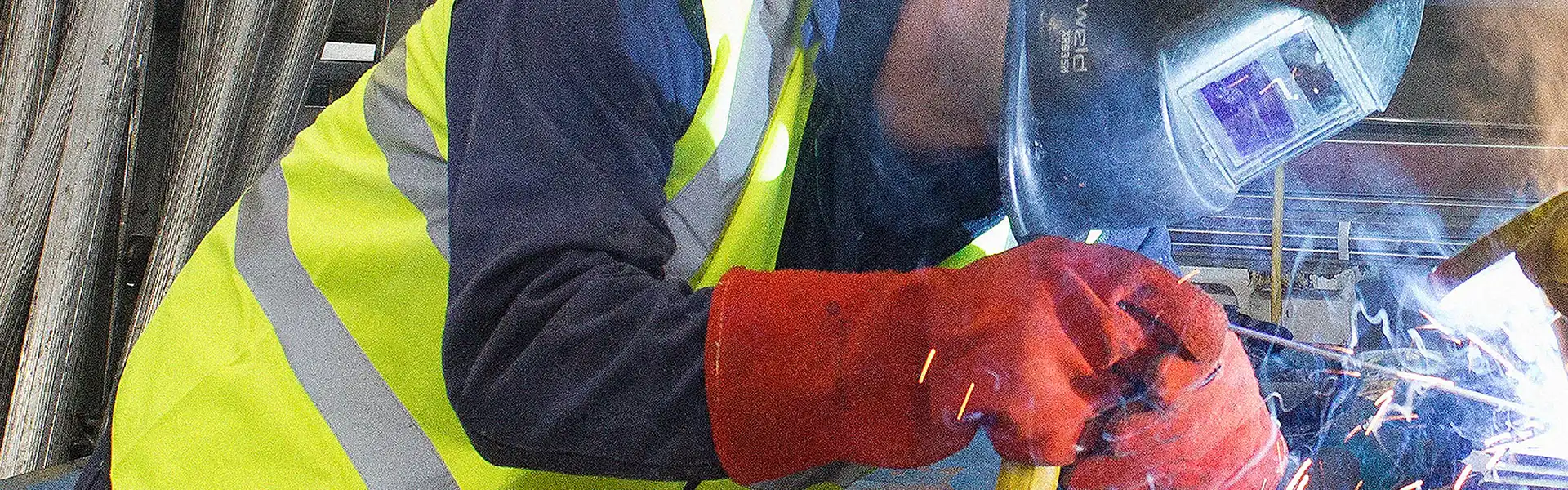
The short answer: Comprehensive guide to welding types — MIG, TIG, MMA/SMAW, and SAW. Pros, cons and best applications for each welding process explained by Varlowe's coded welding team
There are many Welding types, each with its advantages and disadvantages.
It's essential to learn each as each will be more suited to a particular job.
More than 30 different welding types exist, ranging from simple oxy-fuel to high-tech processes such as laser beam welding.
According to The Welding Institute (TWI), MIG/MAG welding (GMAW) accounts for approximately half of all arc welding performed in industrial manufacturing globally — making it the single most widely used welding process worldwide.
Welding is a fabrication process that uses intense heat, pressure, or both to combine two materials, such as two pieces of pipe.
Various welding methods exist for different purposes and use varying techniques, weld positions and other methods.
For more information on Welding, please visit our blog post "What Is Welding?" which provides an in-depth explanation of each welding type.
There are multiple types of welding available today, from manual to fully automated.
The four most common types used here at Varlowe are:
MIG welding is a popular and one of the most accessible welding types. The semi-automated process developed in the 1940s is a subtype of GMAW (Gas metal arc welding).
It appeals to more people due to its more manageable learning curve. Once the correct settings are in place, it doesn't need much to create clean joints.
MIG is an arc welding process where a constant solid wire electrode feeds from a solid wire reel into a welding gun. The wire serves a multi-purpose: it is the heat source and the filler metal for the joint.
FCAW is a variant of the MIG/MAG method. The main difference is that flux-core does not need a shielding gas — a flux-cored wire contains powdered flux in the centre that acts as shielding, allowing outdoor welding. Learn more: Flux-cored arc welding on Wikipedia.
TIG Welding uses a non-consumable tungsten electrode and an inert shielding gas (typically Argon) to protect the weld pool. It is highly versatile but one of the more difficult welding techniques to learn. Learn more: Gas tungsten arc welding on Wikipedia.
TIG is a common type for pipefitters working with high-pressure carbon or stainless pipes.
Stick welding is a manual arc welding method using a consumable electrode covered with flux. It is the oldest welding type and popular due to its simple setup, portability, and cost-effectiveness.
Varlowe Industrial Services specialize in all forms of welding types. Our Class 1 Coded Welders offer services nationwide.
For more information, please visit our Welding Services page or give us a call on 01902 861042.
The main welding types used in industrial fabrication are MIG (GMAW), TIG (GTAW), MMA/Stick (SMAW), Flux-Cored Arc Welding (FCAW), and Submerged Arc Welding (SAW). Each uses a different method to generate the arc and protect the weld pool, resulting in different characteristics suited to different materials and applications.
MIG welding is the most widely used industrial welding process, suited to structural mild steel, general fabrication, manufacturing production runs, and maintenance welding. It is fast, versatile across material thicknesses, and the most straightforward process to automate.
TIG welding is used for precision work requiring clean, accurate welds — stainless steel, aluminium, titanium, and thin-section materials. It is the preferred process for root passes on pipe welds, food-grade and pharmaceutical fabrication, and any application where weld appearance or integrity is critical.
All common welding processes can produce welds as strong as the base material when performed correctly by a qualified welder. The process choice matters less than proper procedure, correct parameter selection, good joint preparation, and operator skill. For safety-critical applications, coded welding to BS EN ISO 9606 provides documented quality assurance regardless of the process used.
TIG welding is generally preferred for stainless steel, particularly for thin sections, precision work, and applications requiring corrosion resistance or visual finish. MIG welding with the correct wire and gas mix is also suitable for thicker stainless steel sections where speed matters.