
Written by the fabrication team at Varlowe Industrial Services — coded welders and steel fabricators based in Wolverhampton with over 20 years of hands-on experience.
The short answer: MIG welding (Metal Inert Gas welding) is an arc welding process where a continuously fed wire electrode melts into the joint while a shielding gas protects the weld pool from contamination. The wire acts as both the arc conductor and the filler metal — which is what makes MIG semi-automatic, fast, and the most widely used industrial welding process in the world. If there's structural steelwork, automotive bodywork, or fabricated plant equipment being built somewhere in the UK today, there's a very good chance MIG welding is involved.
MIG is often the first welding process people encounter — it's more forgiving to learn than TIG, faster than stick, and capable of handling a broad range of materials and thicknesses. But knowing when MIG is the right call, which transfer mode to run, which gas to specify, and when something else is needed — that's what separates a good fabricator from someone who just points a gun at metal.
MIG welding traces its origins to Sir Humphry Davy's demonstration of the electric arc in 1800, but the process we'd recognise today didn't arrive until considerably later. Early experiments in the 1920s by P. O. Nobel of General Electric combined a continuously fed wire with a regulated wire feed rate — but without any shielding gas, the weld was vulnerable to oxidation and atmospheric contamination.
The breakthrough came in 1948 at the Battelle Memorial Institute in Columbus, Ohio. Engineers H. M. Hobart and P. K. Devers developed a process using a small-diameter aluminium wire electrode shielded by argon gas, producing clean spray-transfer welds at deposition rates far higher than TIG or stick welding. The first US patent was issued in 1949. The limitation was cost — inert gases like argon were expensive, initially restricting the process to non-ferrous metals where quality justified the spend.
The cost barrier broke in 1953, when Soviet researchers developed the use of carbon dioxide (CO₂) as a shielding gas. CO₂ was dramatically cheaper than argon, making MIG welding economically viable for steel — by far the most common welding application. The trade-off was a hotter, less stable arc with more spatter, but high deposition rates and low gas costs made it immediately attractive for shipbuilding, construction, and heavy fabrication.
The late 1950s and 1960s saw the development of short-circuit transfer — running fine wire at lower currents so the wire briefly contacts the weld pool roughly 100 times per second, dramatically reducing heat input and enabling welding on thin materials in all positions. This became the most popular variant in general fabrication and remains so today. Pulsed spray transfer, alternating between peak and background current, combined the low-spatter quality of spray transfer with reduced heat input and positional flexibility.
Modern inverter-based machines have since added digital controls, programmable pulsing, and full synergic programmes for different materials. The most significant recent development is the rise of collaborative robots (cobots) — compact, easily programmed welding cells that bring MIG welding automation to small and medium fabrication shops at a fraction of what traditional industrial robots cost.
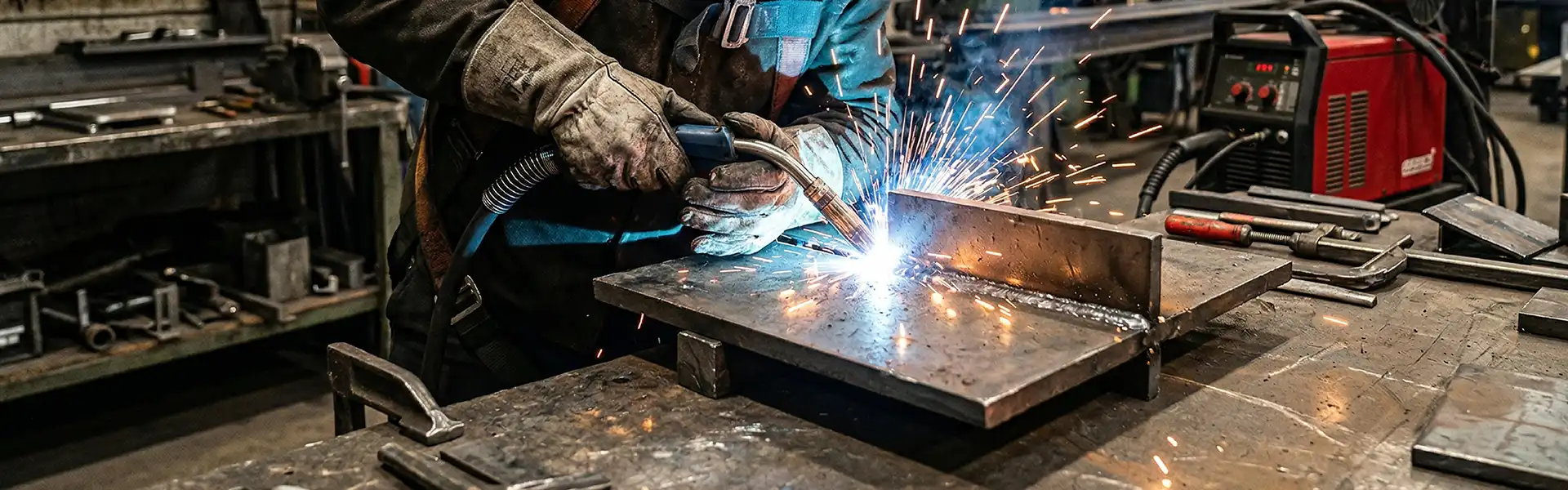
MIG welding creates an electric arc between a continuously fed consumable wire electrode and the workpiece. The wire — which acts as both the electrode and the filler material — feeds automatically from a spool inside the welding machine, through a torch, and out through the contact tip of the gun. When the trigger is pulled, the wire melts into the joint and fuses the base metals together.
The process uses direct current electrode positive (DCEP) polarity in virtually all applications — the wire is positively charged, concentrating heat at the wire tip for faster melting and deeper penetration. The power source is constant voltage (CV), which maintains a set voltage while current adjusts automatically in response to changes in arc length. If the welder moves the gun slightly closer to the workpiece, current increases and the wire melts faster, automatically restoring the correct arc length. This self-regulating mechanism makes MIG significantly easier to control than constant-current processes like TIG or stick.
At the same time, shielding gas flows through the torch nozzle and over the weld pool, pushing oxygen, nitrogen, and moisture away from the molten metal and preventing porosity, oxidation, and contamination. The technical name is GMAW — Gas Metal Arc Welding. Strictly, MIG refers to welding with pure inert gas (argon or helium); MAG refers to active gas mixes containing CO₂ or oxygen. In UK practice, MIG is used to cover both.
One of the most important aspects of MIG welding is how molten metal transfers from the wire to the weld pool. There are four primary transfer modes, and choosing the right one directly affects weld quality, heat input, spatter levels, and what positions you can weld in.
| Transfer Mode | How It Works | Heat Input | Spatter | Positions | Best For |
|---|---|---|---|---|---|
| Short Circuit | Wire touches the pool ~100 times/sec, depositing metal via surface tension | Low | Some | All positions | Thin materials (0.8–6mm); root passes; gap bridging |
| Globular | Large molten droplets form on the wire tip and transfer by gravity | High | High | Flat and horizontal only | Thick carbon steel with 100% CO₂; high deposition on a budget |
| Spray | Tiny droplets stream across the arc in a fine spray | High | Very low | Flat and horizontal mainly | Thick sections (5mm+); high deposition; excellent bead quality |
| Pulsed Spray | Current pulses between peak and background, detaching one droplet per pulse | Medium | Minimal | All positions | Medium to thick materials; aluminium; reduced distortion on thinner work |
Short-circuit transfer is the workhorse of general fabrication — low heat input, all-position capability, suited to thin material and root passes. Spray transfer delivers the highest deposition rates and cleanest beads but is limited to flat and horizontal positions on thicker sections. Pulsed spray bridges the gap: spray-quality results with positional versatility, though it requires a more capable power source.
The consumable wire electrode is both the arc conductor and the filler metal. Wire selection is critical — the wrong wire will produce a weld that looks acceptable but fails under load or in service.
Carbon and low-alloy steel:
| Wire | What It Means | Typical Use |
|---|---|---|
| ER70S-6 | 70ksi tensile, Solid wire, high manganese/silicon deoxidisers | The most common MIG wire; general-purpose mild steel; tolerant of mill scale and light rust |
| ER70S-3 | As above but lower deoxidiser content | Clean, well-prepared mild steel |
| ER80S-D2 | 80ksi tensile, with molybdenum addition | Higher-strength steels; high-temperature applications |
Stainless steel:
| Wire | Typical Use |
|---|---|
| ER308L / ER308LSi | Austenitic stainless steels (304, 304L, 301, 302); low carbon to reduce sensitisation |
| ER316L / ER316LSi | Molybdenum-bearing stainless (316, 316L); improved corrosion resistance in aggressive environments |
| ER309L | Dissimilar metal joints — stainless to carbon steel |
Aluminium:
| Wire | Typical Use |
|---|---|
| ER4043 | Most common aluminium MIG wire; 5% silicon; suited to 6xxx alloys (6061, 6063) and cast aluminium |
| ER5356 | Higher-strength magnesium-bearing wire; 5xxx alloys (5052, 5083); preferred for marine and structural applications |
Aluminium MIG always uses 100% argon shielding gas and typically employs pulsed spray transfer to manage heat input and minimise porosity.
Unlike TIG welding, which uses only inert gases, MIG frequently uses active gases containing CO₂ or oxygen because they improve penetration and arc stability on steel. The gas choice fundamentally affects arc behaviour, penetration depth, spatter levels, and bead profile.
| Gas / Mix | Properties | Typical Use |
|---|---|---|
| 75% Ar / 25% CO₂ (C25) | Best all-round balance of arc stability, penetration, and low spatter; industry-standard MIG gas | Mild and carbon steel — the default choice in most fabrication shops |
| 90% Ar / 10% CO₂ | Smoother arc, less spatter, slightly less penetration than C25 | Thinner mild steel; where a cleaner finish matters |
| 100% CO₂ | Deep penetration, lower cost; rougher arc, more spatter | Budget-conscious structural steel welding; thick sections |
| 100% Argon | Smooth, stable arc; insufficient penetration for steel | Aluminium and other non-ferrous metals only |
| 98% Ar / 2% CO₂ (C2) | Very clean arc; maintains corrosion resistance | Stainless steel MIG welding |
| Ar / He / CO₂ (tri-mix) | Helium adds heat; improved penetration and bead wetting | Stainless steel on thicker sections |
| Ar / 1–5% O₂ | Oxygen stabilises the arc and improves wetting | Stainless steel; some carbon steel applications |
MIG is the workhorse of industrial fabrication. At Varlowe, it sits at the heart of the majority of our steel fabrication and coded welding work. You'll find it across every major industrial sector:
If the job is structural mild steel and volume or speed matters, MIG is usually the sensible call. If the material is stainless, thin, or the weld needs to be clean and precise — TIG is the better option. Many projects use both: TIG for the root pass and MIG for the fill and cap. There's a full breakdown in our post on MIG vs TIG welding, or you can read about what TIG welding is.
MIG welding defects are almost always caused by incorrect parameter settings, poor preparation, or inadequate gas shielding. The most common ones and their fixes:
| Defect | Common Causes | Prevention |
|---|---|---|
| Porosity | Contaminated base metal; insufficient gas flow; draughts; excessive wire stickout | Clean surfaces; check gas flow (15–25 L/min); shield from wind; keep stickout under 12mm |
| Lack of fusion | Incorrect gun angle; travel speed too fast; insufficient heat input | Maintain 0–15° gun angle; keep arc on leading edge of puddle; increase voltage or wire feed speed |
| Burn-through | Excessive heat input; travel speed too slow; common on thin materials and aluminium | Reduce voltage/wire feed speed; increase travel speed; use pulsed transfer on thin materials |
| Excessive spatter | Insufficient gas shielding; dirty materials; voltage too high; excessive stickout | Ensure proper gas flow; clean workpiece; lower parameters; maintain correct stickout |
| Poor penetration | Wire feed speed too low; travel speed too fast; wrong gun angle | Increase wire feed speed; slow travel speed; direct arc into the joint root |
| Convex or ropy bead | Voltage too low; travel speed too fast; incorrect gas mix | Increase voltage; reduce travel speed; verify correct gas composition |
| Cold lap | Travel speed too slow; excessive wire feed speed | Increase travel speed; reduce wire feed speed to match |
The same rule applies as in TIG: cleanliness is the foundation. Clean base metal, clean wire, dry gas, and a spatter-free nozzle and contact tip prevent the majority of MIG defects before the arc is ever struck.
In the UK, MIG/MAG welding is governed by a framework of standards that verify both welder competence and procedural consistency:
Holding these qualifications is often a contractual requirement for work in oil and gas, construction, power generation, and transport. At Varlowe, all welders hold the relevant coded qualifications. We're also ISO 9001:2015 certified — so the quality management behind the weld is as robust as the weld itself.
Our fabrication team has been MIG welding structural steel, mild steel, stainless, and aluminium for over 20 years — in our Wolverhampton workshop and on client sites across the UK. We handle everything from one-off bespoke fabrications to ongoing production runs, and our on-site team can take MIG welding to your site anywhere in the country.
We're not the cheapest option — and we're not trying to be. We're the option you call when you need it done right, on time, and with the paperwork to back it up. Call us on 01902 861042 or drop us a message.
MIG stands for Metal Inert Gas. You may also see MAG (Metal Active Gas), used when CO₂ or an active gas mix is used rather than pure inert argon. The formal technical name is GMAW — Gas Metal Arc Welding. Under BS EN ISO 4063, MIG with solid wire is process 131; MAG with solid wire is process 135.
MIG uses a continuously fed consumable wire that acts as both electrode and filler metal, making it faster and semi-automatic. TIG uses a non-consumable tungsten electrode and a separate filler rod fed by hand, producing cleaner, more precise welds at lower speed. MIG is preferred for structural mild steel and production work; TIG for stainless steel, aluminium, titanium, and precision or safety-critical applications.
For mild and carbon steel, a mix of argon and CO₂ — commonly 75% argon / 25% CO₂ — is the industry standard. For stainless steel, an argon-rich mix with a small addition of CO₂ or oxygen is used. For aluminium, pure argon is required; CO₂ causes porosity in aluminium welds and is not suitable.
It depends on the material and application. Short-circuit transfer is the most common — low heat input, all positions, suited to thin materials and root passes. Spray transfer gives the highest deposition rates and cleanest beads on thicker flat and horizontal sections. Pulsed spray combines spray-quality results with positional versatility and is increasingly common on aluminium and medium-thickness work.
Yes. Aluminium MIG requires a push-pull wire feed system or spool gun to handle aluminium wire, 100% argon shielding gas, and typically pulsed spray transfer to control heat input. It requires an experienced operator — aluminium is far less forgiving than mild steel and burn-through is a constant risk on thinner sections.
Yes, for structural, load-bearing, or safety-critical work. MIG and MAG welding can be performed to coded standards under BS EN ISO 9606-1 (steels) and BS EN ISO 9606-2 (aluminium). Coded welds provide documented quality assurance and are frequently a contractual requirement for structural steelwork, pressure pipework, and industrial plant installations. At Varlowe, all welders hold the relevant coded qualifications.
A correctly executed MIG weld in mild steel — using the right wire, correct parameters, and proper preparation — will typically match or exceed the strength of the base material. Weld strength depends more on operator skill, joint preparation, and process suitability than on the process name. For structural applications, welds should be carried out to the relevant standard by a qualified welder with documentation to prove it.